Français | Deutsch

Welcome!

Welcome to my cyberhome. My blog is directly below; in it you'll find  book recommendations, tips for musicians and for writers, and much more. Elsewhere on this site you can read articles, excerpts from my books, and materials about the Alexander Technique. Enjoy your visit and come back often!

Catalog of Blog Entries

Matisse tries to resist the Naked Beginner

In my artistic explorations, I alternated between working outside (in museums and other public spaces such as parks, parties, and concerts) and working at home, where I often copied faces from art books. I did a dozen Van Goghs, a dozen Picassos, a dozen Rembrandts, a dozen Murillos… It was a wonderful education, and also a wonderful psychological process: to enter another artist’s mind for a moment, to see the world with different eyes, to be in Arles or Spain or 17th-century Holland.

1303411-1575756-thumbnail.jpg1303411-1575755-thumbnail.jpgSome artists were much easier than others to explore. I tried to enter Henri Matisse’s mind, and for some reason I couldn’t find my way in. My first few sketches were so awkward that I knew I hadn’t gained any insight upon Matisse’s perspective. I stayed outside him, I struggled, I remained my own little self. I almost became a stick artist again.


 I think I had some hostility toward Matisse. I’d look at his drawings and say to myself, “What’s the big deal? Why these fat thighs? Can’t the guy draw, for chrissakes?”

1303411-1575758-thumbnail.jpg1303411-1575757-thumbnail.jpgNeedless to say, this wasn’t a judgment of Matisse’s skills—it was a reflection of my own blindness, my own handicaps. One day I decided to draw one of his women with a brush pen instead of a pencil. The pen “required” that I use simplified gestures and lines, not worrying too much about detail or, for that matter, anatomy. With the brush pen the name of the game is “flow.” And I finally “got” Matisse, “got” how freely he worked, how sensuous his figures were, how much depth there was to his simple lines.

I had been looking at his drawings with false suppositions about form, shape, volume, and so on. Maybe Matisse didn’t “need” to think about form and shape, since he’d moved on to the very essence of things!

1303411-1575759-thumbnail.jpg1303411-1575760-thumbnail.jpg1303411-1594888-thumbnail.jpg 


My little Matisse reproductions aren’t straightforward. I put something of myself in them, in particular by coloring drawings that were originally in black and white. To do an exact Matisse seems both impossible and a waste of time, since—well, since the original is already “there.” But a Pedro-ized Matisse? That seemed more interesting to me.

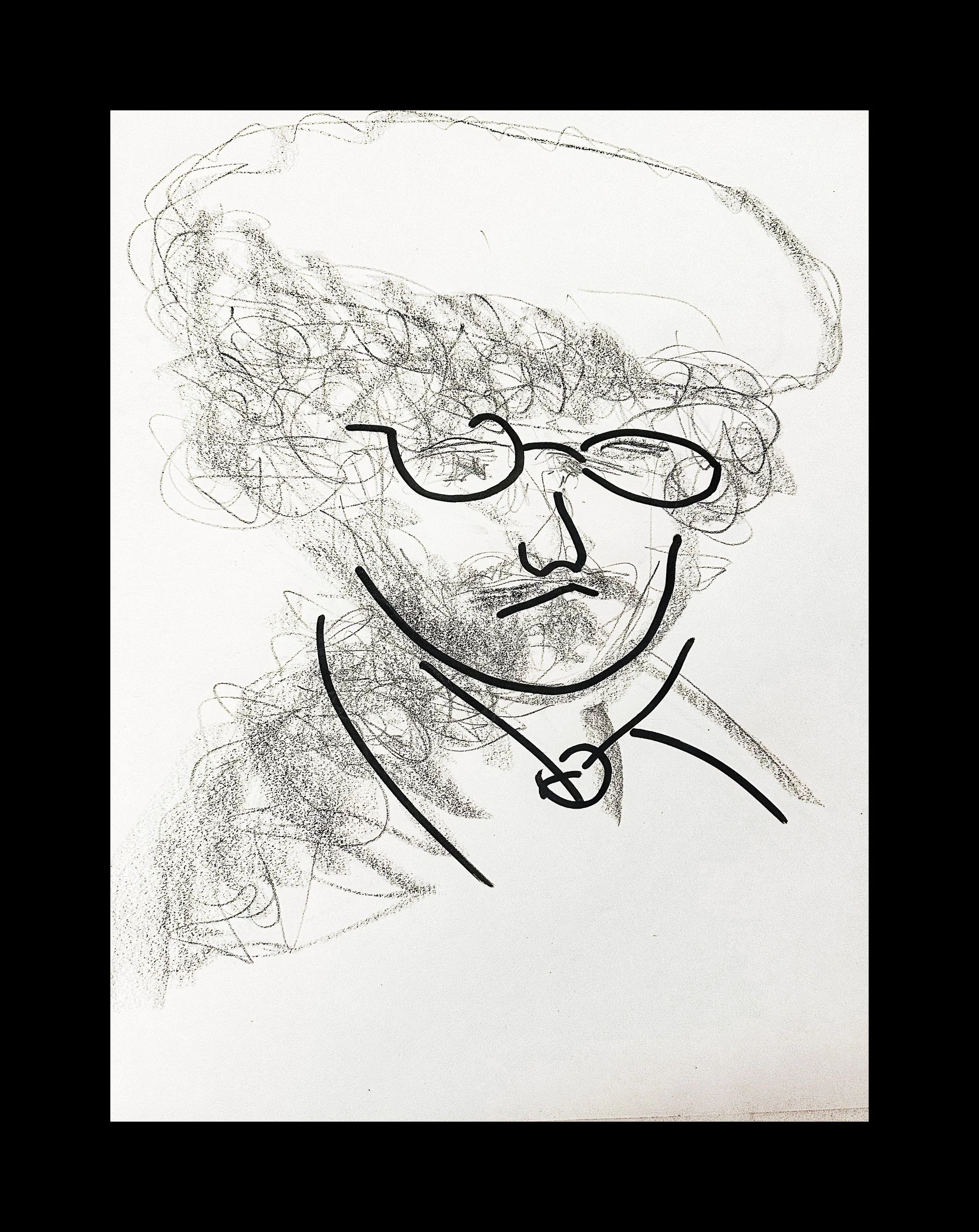
After doing a couple dozen Matisse-inspired drawings, I thought I’d honor the great man by doing a portrait of him, from a photo in one of my wife’s art books.

Matisse%20portrait.jpg
 

Posted on Thursday, July 3, 2008 at 05:39AM by Registered CommenterPedro in | CommentsPost a Comment | EmailEmail

The taboos within

At every juncture in my art education, I’ve had to acknowledge the role that fear played in determining my behaviors. For about 35 years I didn’t draw altogether, and if I’m really honest with myself, then I’d have to admit the ultimate reason for not drawing was that I was afraid of it: Afraid of going wrong, not being good, not being talented; afraid of other people’s judgments; afraid of not controlling what would come OUT of it, as if the pencil risked unleashing some innermost perversion that I wasn’t even aware of.

1303411-1575725-thumbnail.jpg1303411-1575724-thumbnail.jpgYeah, weird. But the only thing is that most people have plenty of fears exactly like mine. And “most people” kinda includes you, dear reader! A hundred fears, big and small, lurk inside us, making us do strange things at work and at home, creating compensating mechanisms, giving us health problems.


1303411-1575727-thumbnail.jpgIt’s good to acknowledge these fears and overcome them, as much as possible.

1303411-1575729-thumbnail.jpgAt first I was afraid of drawing altogether. Then I was afraid of using color in my drawings. Then I was afraid of drawing anything other than human faces. The latter happened in part because when I started drawing, I had decided to offer a daily portrait to my night person, and I had somehow determined that a portrait meant “a human face.” Mental rigidity, pure and simple! To draw an animal was a sort of breakthrough, a deep "letting go." It felt both transgressive and sacred, as if I was going through some sort of rite of initiation.

I know, I know, these are just little drawing of kitty cats and puppy dogs and tweety birds. What can I say? Van Gogh was crazy, too.

1303411-1575726-thumbnail.jpg


Animal%206%20frog.jpg 


Posted on Thursday, June 26, 2008 at 02:26AM by Registered CommenterPedro in | CommentsPost a Comment | EmailEmail

Faces and hearts

As part of my self-education in art, I copied faces from magazines, photographs from ads and articles. Celebrities depicted in magazines and newspapers are sometimes photographed very skillfully. And the celebrities themselves display an intensity of personality, a sparkle, sometimes depths of suffering. One of the reasons these public figures speak to our imagination is because they have the ability to appear greater than us, as if they contained each of us in some way.

1303411-1575810-thumbnail.jpg1303411-1575811-thumbnail.jpgEvery day, as I looked for a photo to reproduce, I’d leaf through a magazine until someone’s face said to me, “I’m interesting and expressive, and you’d enjoy studying me and drawing me. You’ll even learn something about yourself if you do this.” In magazines, it was mostly men’s faces that spoke to me like this. The men were depicted in action, or expressing a strong emotion, their faces creased with lines and bumps, showing a lot of wear and tear—in other words, showing signs of life.

1303411-1575813-thumbnail.jpgAnd the women? Almost without exception, they were made up so that that their skin showed nothing but a single smooth surface. No lines, no creases, no signs of strong emotion; sometimes, no sign of emotion altogether, only an empty placidity, the eyes vacant, not even a trace of a smile. The lighting was such there no shadows appeared upon their faces. The women were photographed not as multidimensional human beings, but as icons of supposed beauty. They’d come across as “beautiful,” or “pretty,” or “handsome,” or “desirable,” or any variation on this single aspect of femininity; but rarely did they come across as “thought-provoking,” “hurt,” “funny,” “powerful,” “scary,” "ugly as sin." More often than not, there was no joy in drawing them.

Okay, folks. Who's going to write in with names for all these faces? Here are a few hints. One is a playright, one is a Hollywood megastar, one is an Australian actor who's also done good in Hollywood. One is the greatest prestidigitator in the world, and also a successful character actor. And two are sportsmen caught in a doping scandal. Names, I want names!

 1303411-1575812-thumbnail.jpg1303411-1575815-thumbnail.jpgSport%20celebrity%201.jpg


Posted on Wednesday, June 18, 2008 at 02:53AM by Registered CommenterPedro in | CommentsPost a Comment | EmailEmail

A splash of red can kill you

During my first few months exploring art, I drew everything exclusively in pencil, black only; most often I used a 4B or 5B pencil. There was a good and a bad reason for me to do this. The good one was a thorough sense of discipline, my saying to myself, “Let's get the hang of this wonderful basic medium here.” The bad one? “I'm afraid of color!” Or, to put it more concretely, “I’m afraid of not knowing what to do and how to do it, I’m afraid of missing out on important stuff, I’m afraid of being revealed as an ignoramus and a fraud. I want my Mommy!”

1303411-1591289-thumbnail.jpgBut eventually I faced my fear. When I finished doing an entire black-pencil sketchbook for my beloved night person, I started experimenting with colors. My wife gave me a useful piece of advice: “Use one color only at first, just to get the feel of it.” So I did: drawings in olive, in red, in brown, simple stuff like that. Then I started using two or more colors together.


1303411-1591290-thumbnail.jpgMy first color breakthrough was drawing a flower—not from a live flower, but from a photo by Irving Penn, simply because that's what I had at hand at the time. I started experimenting, did some perfectly awkward things. But that's the thing: a prerequisite to learning well and quickly is not being afraid of making mistakes, of going wrong. You need to suspend aesthetic judgments for a while—perhaps even forever, if these judgments are imposed from a polluted source, such as people's inane ideas of right and wrong. Or your own inane ideas!


It's not as if we ought to lead our lives with NO notion of right and wrong; on the contrary. But we need to be on the lookout for misconceived and fixed notions of which we aren't even aware. Every day, all day long, we're better off thinking or saying to ourselves, “Maybe I'm wrong, but this is how I see it.” This makes it easier to change our minds once new evidence comes into view. And by new evidence I mean "reality."

Van%20Gogh%20color%201_2.jpg

1303411-1591288-thumbnail.jpg


Color%204.jpg

Posted on Thursday, June 12, 2008 at 02:25AM by Registered CommenterPedro in | CommentsPost a Comment | EmailEmail

Who's worrying about you anyway?

1303411-1585457-thumbnail.jpgFor a few months I kept doing gesture and contour drawings of people and objects in public spaces. I went to a concert of Ron Carter, the great jazz bassist, and even while he played I sketched him, his guitarist colleague, and members of the public. I attended an informal play and sketched the heads, faces, and backs of theatergoers sitting near me. At a big party for my father-in-law's 70th birthday I drew guys dancing, guys laughing, guys asleep after drinking a few too many... Sitting at sidewalk cafes I drew passersby and fellow coffee drinkers. On occasion I rode the métro with a little notebook and discreetly sketched passengers.

Social convention would tell us that sketching people without their permission is a no-no, an invasion of privacy. So far I haven't had any problems with my public sketching. Either nobody noticed it; or if anyone noticed no one was bothered by it; or if anyone was bothered no one told me. It was another interesting lesson, to see that social settings afford a certain leeway of action; you can do more things in public than you normally assume. Another lesson, another liberation: shackles are self-imposed, including those of social behavior.

1303411-1575823-thumbnail.jpg

1303411-1575822-thumbnail.jpg

 From the point of view of craft, sketching people in public is interesting because most of the time you need to finish the sketch within seconds of starting, before someone moves and the "pose" is lost. The brain, eye, hand, and heart all come together, and for ten seconds you're in the moment, intensely alert, concentrated. Little by little this attitude becomes your habit, and you remain always in the moment.

 There's been an unexpected benefit to my sketching: It seems to me that as I become more observant, I also become more appreciative of people. When you pay attention and really look, people turn out to be quite fascinating. Everyone has a certain presence or energy; everyone has lived and suffered; everyone has something to offer to this world.

Public%20face%205%20grayscale_2.jpg 

Posted on Wednesday, June 4, 2008 at 02:41AM by Registered CommenterPedro in | CommentsPost a Comment | EmailEmail

Fear is a choice you make

I live about a twenty-minute walk from the Pompidou Center in Paris, and for a few years now I've been a member—meaning I can go in for free all year long! One of my Sunday pleasures is to stroll through the Marais on my way to the Pompidou, sit at the cafe inside it reading or writing for a while, then spend some time looking at the permanent collection or whichever temporary exhibits are up on that day.

Recently I attended a retrospective of Alberto Giacometti, the great Swiss sculptor famous above all for his very elongated figures. As it happens, some time ago—I think about three years—there was another Giacometti show at the Pompidou, focusing on his drawings and sketches. The show included some very expressive portraits that Giacometti had drawn with cheapo ballpoint pens, those same pens that you and I use to jot down a shopping list or write a check. Looking at the sketches I had though, "I wish I could do this too." And the thought was wistful, tinged with envy and perhaps even a touch of bitterness. The day after I saw the show I bought myself a dozen ballpoint pens (red, blue, black, and green) and a notebook, and I put them all away in a hidden corner of my workspace.

1303411-1575709-thumbnail.jpg


I wasn't ready.


But when the time finally came for me to start drawing, one of the things that got me going was the memory of Giacometti's ballpoint sketches, and the wistful yearning they had triggered. So you can imagine how happy I was to go visit a new Giacometti show, notebook and pencil in hand. This time I was “doing,” instead of “wishing I could do it.” Two very different attitudes, one sad, one happy; one envious, one celebratory; one handicapping, the other enabling. It doesn't matter if I can't begin to draw as well as the great masters; what really matters is that I'm not afraid of drawing anymore; I'm not envious, I'm not jealous, I'm not self-defeating!


1303411-1575710-thumbnail.jpg


Needless to say, I could have been drawing all my life. There wasn't a single GOOD reason for me not to draw, only a misconception I had created about myself and my capabilities or lack thereof.


Drawing is a wonderful thing. But dispelling a burdesome misconception about yourself is even more wonderful.

1303411-1575711-thumbnail.jpg1303411-1575712-thumbnail.jpg

Posted on Thursday, May 29, 2008 at 03:51PM by Registered CommenterPedro in | CommentsPost a Comment | EmailEmail
Page | 1 | 2 | 3 | 4 | 5 | Next 6 Entries